You have reached the perfect spot to discover more about the mysterious concept of what is an API , which powers every program we use on a regular basis both online and on our phones.
Application Programming Interfaces, or APIs for short, make communication and interaction between various software systems possible..
Behind the scenes, APIs make sure everything works: delivering messages in a chat app, handling online payments, and more. In this blog, we discuss what is an API , how it works, and why both developers and businesses need to know it.
This article will provide you with a clear overview of APIs, irrespective of whether you are new to technology or if you want to learn more about it.
Also read: Python Modulo Explained: A Beginner’s Guide to the % Operator
Demystifying what an APIs is: How They Work and Why They’re Essential for Today’s Digital World
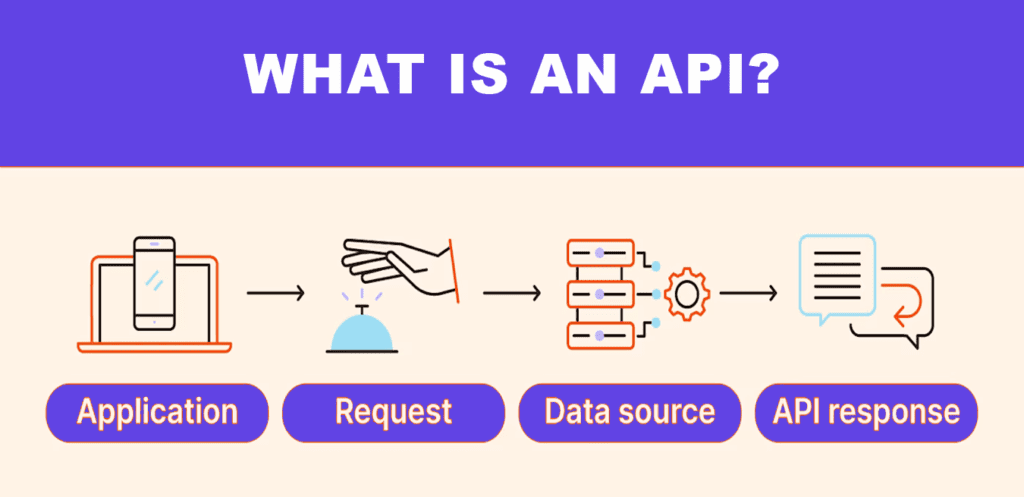
You are really digging into the heart of how most contemporary digital services interact when you ask, “What ia an API?” In short, an API is a set of rules that provide several software applications the ability to communicate with one another. The two systems may be able to interact and understand one another even if they may speak completely different “languages” because of APIs, which can serve as translators.
For example, when you check the weather on your smartphone, your app probably uses an API to retrieve data from an external weather service.”This program asks ‘What is the temperature where I am?’ to the weather provider’s API.” The app shows any data that the API produces. If you had these kinds of real-time data without APIs, it would be much harder, and your current software would do miserably.
Another example would be when using a Facebook or Google account for logging on the website. Another example of the API in play is when one uses his login information on a Google or Facebook account to use these services from a single point of login with no need for creating a unique username and password for every single website.Instead of having you to learn their passwords, the API confirms your identity with Google and Facebook’s servers and grants you access without using a significant amount of time.
API has been the main backbone of how the current world works seamlessly digitally. They allow companies to enhance user experience, integrate services, and develop more innovative solutions. APIs are the unsung heroes that power contemporary technology-from linking different apps to processing online payments or fetching data from a third-party service. To be able to completely take advantage of the interwoven systems that make our digital lives so smooth, one must grasp what is an API and how it works.
How APIs Simplify Integration and Boost Innovation in Technology
One of the biggest reasons why the APIs are so efficient is that they support technological innovation and make it easier to integrate. For discussion purposes only, while explaining what is an API and how it works, it is evident that APIs allow communication between different software programs, share information, and work together without a complete system redesign or rebuild.
This flexibility allows saving time and reducing complexity with the creation of countless opportunities for new products and services.
For instance, consider the case of online transactions. Take a case like how PayPal or Stripe makes use of APIs in doing transactions. No single e-commerce site will take time to set up a different payment system for every other customer; these systems have an API that one can easily incorporate into the site and receive instant payment services while remaining assured that their transaction was safe and guaranteed.
The other is that APIs facilitate innovation when programmers incorporate new features into existing systems. For instance, API integration leads to ride-sharing apps like Uber. For example, Uber uses APIs to integrate a wide range of payment methods, communication tools, and maps into its platform.
The APIs allow the app to communicate with other services like Google Maps for navigation or a payment gateway for any transaction, hence the user experience is smooth and effective. If not for APIs, Uber would have to come up with all these services from scratch. Innovations in such would be slower and less considerable
Types of APIs
There are 6 basic types of APIs
Open APIs (Public APIs)
These APIs are available to developers and other users with minimal restrictions. Open APIs are often used to allow third-party developers to build applications or integrate services with existing platforms. For example, Twitter offers an open API that allows developers to create apps that interact with Twitter’s data and functionality.
Internal APIs (Private APIs)
Inner APIs are utilized inside an association and are not presented to outer clients. These APIs help different teams or departments within a company integrate and share data with each other, improving workflow and efficiency. For instance, an HR department might use an internal API to pull employee data from a payroll system for reporting purposes.
Partner APIs
Partner APIs are shared between specific organizations or partners to facilitate collaboration and integration. These APIs are typically more secure than open APIs and come with certain access controls. A real-world example is the API that allows an online retailer to connect with a logistics company to track shipments and provide delivery updates.
RESTful APIs
Representing State Transfer, or REST, APIs are probably the most common type of web service in today’s online and mobile applications. This allows systems to interact over HTTP by utilizing common HTTP methods like GET, POST, PUT, and DELETE. As an example, many web-based services, such as Spotify or Google Maps, offer RESTful APIs to allow developers to include their features in other applications.
SOAP APIs (Simple Object Access Protocol)
However, when compared with REST APIs, SOAP APIs are far more strict and planned.
. They are normally used in the more complex enterprise-level systems. They are standards-compliant as well. If a system that requires high levels of security has to be interfaced, say, a banking application, SOAP APIs are just the right option because they carry data in XML format and provide built-in protection mechanisms most of the time
GraphQL APIs
GraphQL is easier to choose over REST since it allows clients to define exactly what information they want, perhaps sending the least amount of data. It is also more effective in managing big databases or several services. Because it underpins Facebook’s APIs, developers can query their data with more accuracy and flexibility.
Advantages of APIs:
- Faster Development:APIs allow developers to use existing services, saving time instead of building everything from scratch.
- Efficiency: They automate tasks and make systems work faster by enabling seamless communication between different apps.
- Improved User Experience: APIs provide real-time data, enhancing apps with features like weather updates or payment processing
- Better Security: APIs can offer secure data access with built-in protections like authentication and encryption.
- Cost-Effective: By reusing APIs, businesses save money on development and focus on their core services.
- Scalability: APIs make it easier to expand and add new features to your system as your needs grow.
Disadvantages of APIs:
- Complexity in Integration: Many APIs will be connected, which will be hard and perhaps necessitate continuous maintenance.
- Versioning Issues: The wrong implementation of an API change, such as a new version, may immediately cause a crash in your software.
- Cost of API Usage: Applications that use a lot of APIs view them to be expensive especially if they have limits or based on usage.
Conclusion
To understand the significant role that APIs play in the modern digital world, one has to know first what is an API and how it works. APIs are the core of most modern technologies and services, whether it is for streamlining development and increasing user experiences or to encourage innovation and strengthen security.
They allow businesses to include third-party technology, scale their systems the right way, and give consumers smooth digital experiences. On the other hand, aside from security threats and reliance on third-party services, most enterprises conclude that the advantage of using APIs much outweighs the disadvantage.
APIs are a greatly powerful tool, especially for a developer, business owner, or simply an interested tech fan who is looking at how technology and digital innovation continue to shape the future.